
Quality Control
Quality Controls are carried out through non-destructive tests (NDT), wich are carried out with high-technology elements handled by highly-qualified operators.
By employing these NDT techniques, marine services companies can identify potential issues early, prevent failures, ensure compliance with regulatory standards, and ultimately enhance the safety, reliability, and longevity of marine structures and vessels.
Ultrasonic Testing (UT)
UT involves the use of high-frequency sound waves to detect flaws or discontinuities within materials or welds. In marine applications, UT can be used to inspect the thickness of hulls, pipelines, and structural components, as well as to detect cracks, voids, or corrosion.
- Probe Placement: A trained technician places an ultrasonic transducer on the surface of the hull. The transducer emits high-frequency sound waves into the material.
- Sound Wave Propagation: The sound waves travel through the material until they encounter the back wall or a change in material density, such as corrosion or a decrease in thickness.
- Reflection and Measurement: When the sound waves encounter a change in density, part of the wave reflects back to the transducer. By measuring the time it takes for the sound waves to travel to the back wall and back, the thickness of the material can be calculated.
- Data Analysis: The data collected from the reflected waves is analyzed to determine the thickness of the hull at various points.


Magnetic Particle Testing (MPT)
MPT is used to detect surface and near-surface flaws in ferromagnetic materials such as steel. A magnetic field is applied to the material, and magnetic particles are applied to the surface. Flaws disrupt the magnetic field, causing the particles to gather at the flaw locations, making them visible under appropriate lighting conditions.
- Inspect welds for surface and near-surface defects, such as cracks, lack of fusion, porosity, or incomplete penetration. Welds in critical areas, such as hull structures, pressure vessels, or piping systems, undergo MPT to ensure they meet quality and safety standards.
- Hulls and Structural Components: The hull of a ship and other structural components are subjected to MPT to detect surface and subsurface defects that may develop over time due to corrosion, stress, or other factors. MPT helps identify cracks, weld defects, and other flaws that could compromise the structural integrity of the vessel.
- Engine and Machinery Components: Critical components of ship engines and machinery, such as shafts, gears, and bearings, may undergo MPT to ensure they are free from surface and subsurface defects that could lead to mechanical failures.
- Rigging and Lifting Equipment: Rigging components, such as shackles, hooks, and chains, as well as lifting equipment, such as cranes and hoists, are inspected using MPT to detect defects that could pose safety hazards during lifting and handling operations.
Infrared Thermography (IRT)
IRT utilizes infrared cameras to detect and visualize thermal patterns and temperature differences on the surface of materials or components.
Fault detection
The rocess of identifying and diagnosing abnormalities, defects, or anomalies in the structure, systems, machinery, or components of ships and vessels.
Testing of Booms and Loading
Tihs testing involves subjecting the equipment to loads that simulate actual operating conditions and monitoring for any signs of deformation, deflection, or failure.
Rocking Test
Winch braking
Immersion suits, ladders and defenses
Lifeboat Release, Davit and Winches
Hydraulic and dielectric hose tests
Hydraulic and dielectric hose testing are two types of Non-Destructive Testing (NDT) methods commonly used in the marine industry for ensuring the integrity and reliability of hoses used in hydraulic systems and electrical insulation systems onboard ships and vessels.
- Hydraulic Hose Testing: Hydraulic hoses are critical components of hydraulic systems onboard ships, used to transmit hydraulic fluid to various machinery, equipment, and actuators. The integrity of hydraulic hoses is essential for the safe and efficient operation of hydraulic systems.
- Dielectric Hose Testing: Dielectric hoses are used in electrical insulation systems onboard ships to protect against electrical shocks and ensure the safe transmission of electrical power. Dielectric hose testing is essential for verifying the insulation integrity and electrical performance of these hoses.


Dye Penetrant Testing (PT)
PT is a method used to detect surface-breaking defects in non-porous materials. A penetrant dye is applied to the surface of the material, allowed to seep into surface flaws through capillary action, and then excess dye is removed. A developer is applied to draw out the penetrant from the flaws, making them visible.
In the marine industry, Dye Penetrant Testing is commonly used for inspecting critical components of ships and vessels, including:
- Welds: Dye Penetrant Testing is used to inspect welds for surface cracks, lack of fusion, undercutting, or other defects that could compromise the integrity of the weld joint.
- Hulls and Structural Components: The hull of a ship and other structural components are subjected to Dye Penetrant Testing to detect surface defects that may develop over time due to corrosion, stress, or other factors.
- Engine and Machinery Components: Critical components of ship engines and machinery, such as shafts, bearings, and gears, may undergo Dye Penetrant Testing to ensure they are free from surface defects that could lead to mechanical failures.
- Pipelines and Piping Systems: Piping systems onboard ships are inspected using Dye Penetrant Testing to detect surface defects, such as cracks, corrosion, or weld discontinuities, that could compromise the integrity of the system.
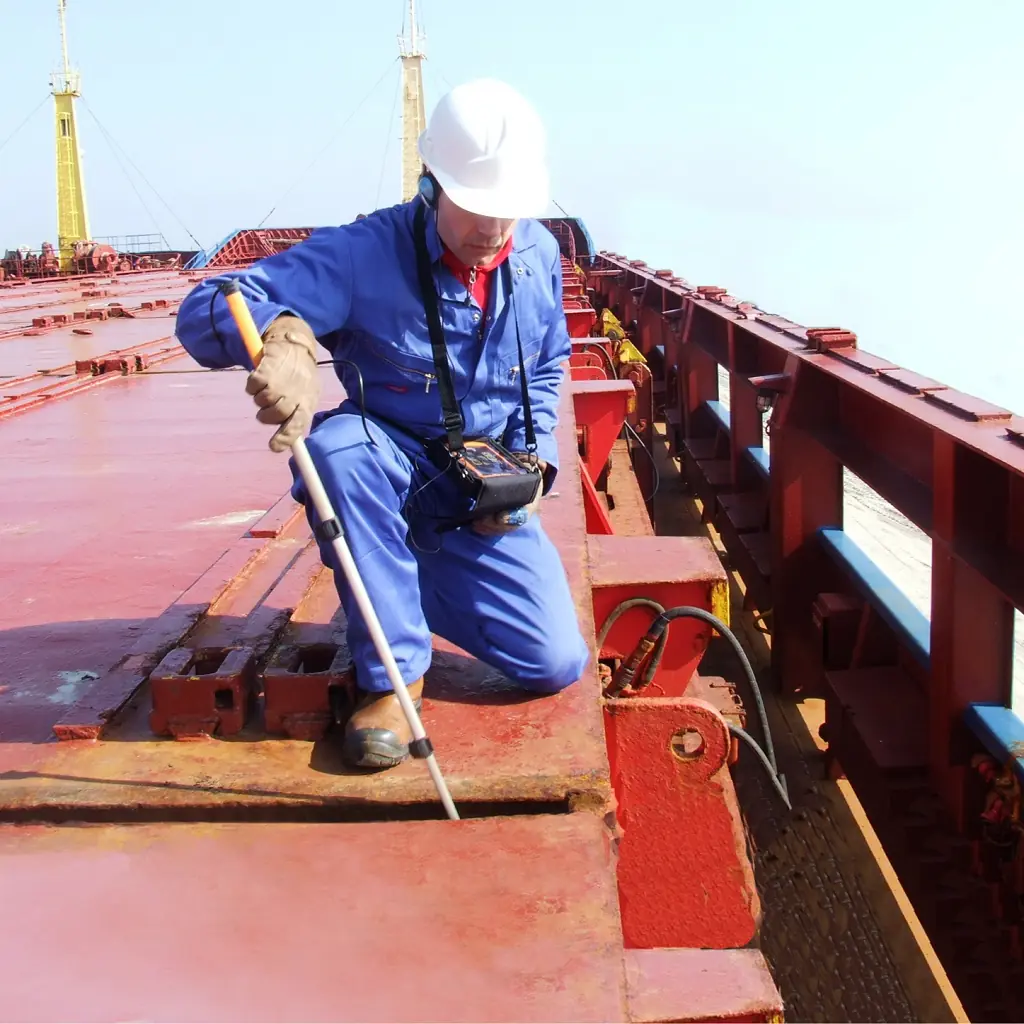
Ultrasonic Hatch Cover Testing
The ingress of water through leaking hatch covers is a main cause of damage to cargo. It is in the interest of ship owners, managers and insurers to guarantee the cargo hold is watertight, as damaged cargo caused by water leaking through hatch covers often results in large claims against insurance companies and P&I; clubs. Hatch cover testing is a vital part of cargo ship maintenance.
The ultrasonic hatch cover weather tightness tester provides a quick and simple method of establishing weather tightness of hatch covers, bow, stern and side doors, but unlike hose testing, UT testing has no negative side effects on the port or harbour environment. Our ultrasonic hatch cover weather tightness tester can be performed in sub-zero temperatures.


Senat Marine Service
Contact
Tel./Fax: +54 11 4312 4905
Mobile:+54 11 6126 1525
info@senatgroup.com
Address
Tres Sargentos 421, 4th Floor, of. 8 – C1054ABC – Buenos Aires – Argentina.